

A fan website is your own paid hub where content, audience, and monetization come together under your control. Instead of relying on a typical fan page, you manage pricing, user data, and how fans interact with you. Income comes from subscriptions, direct messages, and gated content, all working inside one system. You don’t need to build everything from zero either, since white-label solutions let you launch faster while still keeping full ownership.
You already did the hard part. You built an audience. People follow you, react to your content, maybe even pay. But everything still lives on platforms you don’t control. The design isn’t yours, the rules can change overnight, and reach depends on algorithms you never agreed to. It’s a strange position to be in: you have subscribers, but no real place that feels like yours.
This is where the idea of a fan website starts to matter. Not as a side project, but as a central hub. If you’ve ever wondered what is a fan page today, the answer has shifted. It’s no longer just a page with updates and photos. And if someone asks what is fan page in practical terms, the real answer is closer to a system than a page.
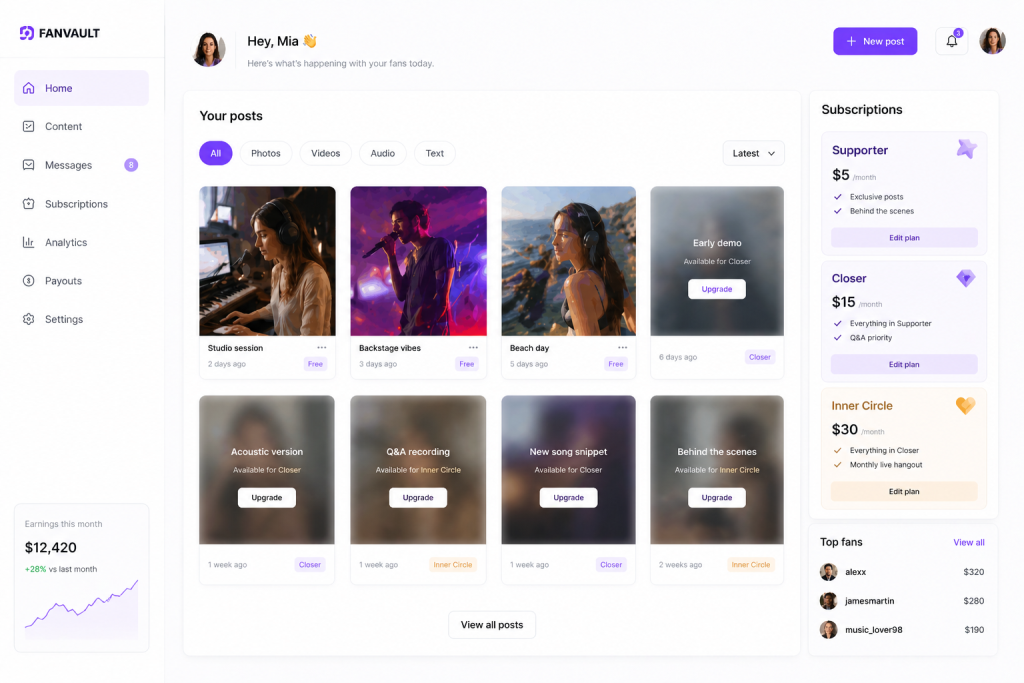
A modern setup isn’t just a fan page website or a simple fan site. It’s a structure built around monetization and control. You decide how people subscribe, what content is locked, how direct messaging works, and what you sell. Subscriptions, gated posts, private messages, digital products. Everything sits in one place, under your brand, working together instead of being scattered across apps.
From Fan Page to Revenue Engine: What Actually Changed

Not long ago, a fan page was simple. You posted updates, shared photos, maybe replied to comments if you had time. A typical fan site followed the same pattern. It was about visibility, not revenue. People followed, you posted, and that was it.
That model started to break when creators realized attention doesn’t automatically turn into income. You could have thousands of followers and still struggle to earn consistently. The issue wasn’t content quality. It was the lack of structure behind it.
Now the concept has evolved into something closer to a fanpage website. Instead of acting like a feed, it works as a system. Content is layered. Some posts are public, others are locked behind access. Subscriptions define what people can see. Messaging becomes part of the experience, not just a side feature. You’re no longer just publishing, you’re managing a flow.
Across modern fan websites, the key shift is control. You’re not relying on reach that comes and goes. You decide access, pricing, and interaction. That’s why more creators are moving away from platforms that sit between them and their audience.
“Creators are increasingly shifting toward platforms where they control audience relationships and revenue streams directly.”
— Axios
Once that shift clicks, a fan page stops being a page. It becomes a working revenue system.
What Makes a Fan Website Actually Work (Core Mechanics)

A working fan website isn’t just a place where content sits. It’s a system where every element pushes a user toward engagement or payment. When people think about a fan site, they often imagine posts and updates. In reality, what drives revenue is how those pieces connect.
The first layer is monetization, but not in a flat way. It’s stacked:
- subscriptions with different access levels
- pay-per-view or locked posts for specific content drops
- paid private messages where attention itself becomes a product
- digital products or merch that extend beyond content
Each piece does a different job. Subscriptions create predictable monthly income. Locked content adds spikes. Messages bring high-margin interaction. Together, they form a balanced model inside a fan website, instead of relying on a single source.
Behind that visible layer, the structure matters even more. This is where most fan page website attempts fail. They show content but don’t guide behavior. A working setup usually includes:
- a simple paywall flow: free content → teaser → locked content
- basic segmentation: active fans, high spenders, silent followers
- retention triggers: notifications, scheduled drops, replies that feel personal
This is where a fan website starts behaving less like a page and more like a system. You’re not just publishing. You’re managing access, timing, and interaction. Even small changes, like when you release content or who sees it first, directly affect revenue.
Fan Website vs Social Platforms vs Basic Website
| Feature | Social Platform | Basic Website | Fan Website |
| Audience ownership | No | Yes | Yes |
| Monetization | Limited | External | Built-in |
| Direct messaging | Limited | No | Yes |
| Paywall | No | Manual | Native |
| Revenue control | Low | Medium | Full |
| Algorithm dependency | High | None | None |
A basic site gives you control over design and content, but monetization usually sits outside it. You need extra tools, plugins, or third-party services. A fan website combines everything into one flow. Payments, access, and interaction work together. That’s the difference between having a presence and actually running a system that earns.
Content Rhythm: Why Most Fan Websites Fail Quietly

A fan website doesn’t break because of design or features. It breaks when nothing feels alive. You open it, scroll a bit, and realize nothing new has happened for days. That’s enough for most people to stop coming back.
The difference between a working setup and a dead one is rhythm. Not just posting often, but posting with intent. Think in sequences, not isolated posts. A teaser builds tension. The main drop delivers something worth paying for. Then comes the follow-up, where the real interaction happens. Without that last step, you’re leaving money on the table.
A simple weekly flow can already change everything. Early in the week, you publish something open that pulls attention. Midweek, you release locked content connected to it. Toward the end, you reach out directly, answer messages, or offer something extra. It doesn’t have to be complex. It just has to repeat.
There’s also a warm-up layer that many ignore. New people shouldn’t hit a paywall immediately. They need a moment to understand what they’re getting. Free content draws them in. Slightly deeper content keeps them around. Paid content then feels like a natural next step, not a forced decision.
Even strong fan websites lose momentum without this structure. Gaps kill anticipation. Random posting breaks the habit. When there’s no rhythm, people don’t feel like they’re missing anything, and that’s when they leave.
Mini Economics: What a Small Fan Hub Can Generate
You don’t need a huge audience for a fan website to start making money. What matters is how many people convert and how long they stay.
Here’s a simple breakdown:
300 followers × 5% conversion = 15 paying fans
15 fans × $15/month = $225 base revenue
Upsells (messages, locked content):
15 fans × $10 average = $150
Total monthly revenue:
$225 + $150 = $375
Now the important part. This only works if people don’t leave immediately.
If those same 15 fans stay for 3 months:
$375 × 3 = $1,125
Retention changes the math more than growth. If you reduce churn from around 40% to 20%, the same audience generates more repeat revenue without adding new users. Over time, each subscriber becomes more valuable, because they stay longer and spend more across messages and locked content.
This is why small improvements in retention often outperform audience growth in real revenue terms.
This is where most people get it wrong. They focus on growing followers instead of keeping the ones who already pay. A fan website doesn’t scale like social media. It grows through retention. If users stay longer, even small numbers turn into stable income.
How to Make a Fan Page That Actually Pays
If you search how to make a fan page, most advice stops at “post regularly” and “add nice visuals.” That’s fine for a hobby page. It won’t build a paid fan website. You need positioning, pricing, content flow, and a place where payments and access work without duct tape.
Six steps before you launch
- Pick a clear positioning
Decide what people are paying for. Is it personality, expertise, behind-the-scenes access, private updates, tutorials, lifestyle content, or community? A vague fan page is easy to ignore. A focused one gives people a reason to subscribe. - Choose the monetization model
Start with one main offer. Monthly access is usually the base. Then add locked posts, private messages, paid requests, digital files, or merch. Don’t open ten revenue streams on day one. Two or three clean options are easier to understand and sell. - Set pricing tiers
A simple structure works best: entry tier, core tier, premium tier. For example, $9 for updates, $19 for exclusive drops, $49 for priority replies or special access. Pricing should match effort. If the top tier needs daily personal attention, price it like your time matters. - Build the content system
A fan page website needs more than uploads. Plan free teasers, paid drops, recurring formats, and follow-ups. Give people a reason to check in every week. Random posts create random income. - Choose the platform or infrastructure
A basic fanpage website can look good, but monetization often requires plugins, payment tools, login logic, and manual fixes. A paid hub needs subscriptions, user accounts, paywalls, messaging, and analytics working together. - Launch with a soft funnel
Don’t ask everyone to pay immediately. Invite warm followers first, test pricing, watch what they click, then adjust. Your first version should teach you what people actually buy. That feedback is worth more than a perfect design.
Platform Choices: Build, Hack, or Use a Ready System
At some point, every creator hits the same question. Where should this actually live? A fan site can start almost anywhere, but once money enters the picture, the choice of setup becomes critical.
The DIY route usually begins with WordPress and a stack of plugins. On paper, it looks flexible. You can install memberships, payment gateways, messaging tools, analytics, all piece by piece. In practice, it turns into maintenance. Things break, updates conflict, payments need testing, and user experience depends on how well everything connects. It works if you have time or a developer, but it rarely feels like one clean system.
SaaS tools take the opposite approach. They’re fast to launch and easy to use. You get subscriptions, content locking, maybe messaging, all in one place. TThe trade-off shows up later: fees, platform rules, branding limits, and restricted access to user data. You don’t fully control pricing logic or how features evolve. You’re building on someone else’s terms.
White-label solutions sit in the middle but behave differently. You get a ready structure with monetization, messaging, and access control already integrated, but it runs under your brand and domain. You’re not stitching tools together, and you’re not locked into someone else’s ecosystem either. The system is already built, but the ownership stays with you.
This is why many creators move beyond a simple fan site. A basic setup is enough to post content. A real fan website needs infrastructure that supports growth, not just presence.
Copyright and Content Ownership
One practical point that often gets ignored. A fan website can include paid content, but that doesn’t mean you can upload anything you want. If your project is built around a public figure, brand, or media content, you need to be careful with copyrighted materials. Photos, videos, logos, music, and branded assets usually require permission or licensing. The safest approach is to create original content or use materials you have rights to. This becomes even more important once you introduce payments, since monetization increases legal exposure.
Scrile Connect: Launch Without Platform Dependency

At some point, the problem becomes obvious. You’ve built an audience, maybe even a steady stream of paying users, but everything still depends on platforms you don’t control. The branding isn’t yours, the rules can change, and growth feels unpredictable. That’s exactly where a white-label solution starts to make sense.
Scrile Connect is a white-label system designed as a foundation you can build on, not a place you have to adapt to. It doesn’t position you inside a marketplace. It gives you your own space with the tools already working together.
What that actually means in practice:
- your own domain and fully branded environment
- built-in subscriptions, pay-per-view content, and paid messaging
- user accounts and access control managed in one system
- direct interaction with your audience without intermediaries
- flexibility to adjust pricing, content structure, and features
- no dependency on algorithms deciding who sees your content
The key difference is ownership. You’re not borrowing reach or visibility from a platform. You’re running your own setup where traffic, interaction, and payments connect in one place.
This ties directly back to the earlier issue. Instead of spreading content and monetization across different tools, everything finally sits under one structure that you control.
What Setup Fits Your Situation
| Situation | Audience Size | Monetization Focus | Key Features Needed | Main Risk | Best Setup |
| Beginner creator | 0–1,000 followers | First conversions | 1–2 tiers, simple paywall, basic content drops | Overcomplicating early | Simple structured setup |
| Early growth | 1,000–10,000 | Stable monthly income | Subscriptions + locked posts + basic messaging | Weak retention | Layered monetization system |
| Scaling creator | 10,000+ | Revenue optimization | Paid messaging, segmentation, scheduled drops | Burnout / chaos | Structured system with clear flows |
| Established brand | 50,000+ | High LTV & control | CRM logic, priority access, premium tiers | Platform dependency | Fully branded hub |
| Agency / multi-creators | Multiple accounts | Scalable revenue | Multi-user control, analytics, centralized management | Fragmentation | White-label scalable solution |
Conclusion
At some point, growth stops being the problem. Control becomes the real issue. You can have traffic, engagement, even paying users, but if everything sits on platforms you don’t own, you’re always working within someone else’s limits.
Owning a fan website changes that dynamic. You decide how people join, what they see, and what they pay for. Pricing isn’t fixed by platform rules. Content isn’t filtered by algorithms. Your audience isn’t just a number on a dashboard. It’s a group you can actually interact with, segment, and build around.
That’s where stability comes from. Not from chasing reach, but from building a system that holds attention and converts it over time. Even small audiences become valuable when they stay, engage, and spend consistently.
The difference is simple. You move from posting content to running a structure. One that connects content, interaction, and revenue in a way that keeps working, not just when something goes viral.
If you’re ready to move in that direction, the next step is practical. Contact the Scrile Connect team and start building a setup that you fully control.
FAQ
What is fan websites?
Fan websites are online spaces created around a creator, public figure, niche, community, or brand. In a monetized version, the site can include subscriptions, gated content, private messages, and paid access instead of working only as a public fan page.
How do I create a fan website?
Start with a clear niche, decide what fans will pay for, create free and paid content categories, set subscription tiers, add payment logic, and choose infrastructure that supports user accounts, paywalls, messaging, and content updates.
Is it legal to create a fan page?
Yes, it can be legal to create a fan page, but you must be careful with copyright and trademarks. Do not publish protected photos, videos, logos, music, or branded materials without permission. Monetization makes compliance even more important.
How does a fan website make money?
A fan website can earn through monthly subscriptions, paid messages, locked posts, digital downloads, merch, premium access, and one-time content purchases. The strongest model usually combines recurring revenue with smaller upsells.
What features should a fan website include?
A useful fan website should include user registration, subscription tiers, gated content, payment processing, direct messaging, content categories, mobile-friendly design, analytics, and simple admin tools for updates and user management.
Can I build a fan website without coding?
Yes. You can use website builders, plugins, SaaS tools, or white-label solutions. For a paid hub, no-code tools may work at first, but subscriptions, messaging, and paywalls need reliable infrastructure.
What is the difference between a fan page and a fan website?
A fan page usually lives on a social platform and focuses on updates, posts, and engagement. A fan website is owned space with branding, payment logic, gated content, user accounts, and more control over audience relationships.
How much does it cost to start a fan website?
Costs depend on the setup. A basic DIY version can be cheap but limited. A more serious paid hub needs subscriptions, payments, paywalls, hosting, design, and maintenance. White-label development costs more upfront but gives stronger control and scalability.

Polina Yan is a Technical Writer and Product Marketing Manager at Scrile, specializing in helping creators launch personalized content monetization platforms. With over five years of experience writing and promoting content for Scrile Connect and Modelnet.club, Polina covers topics such as content monetization, social media strategies, digital marketing, and online business in adult industry. Her work empowers online entrepreneurs and creators to navigate the digital world with confidence and achieve their goals.