Searches for “free undress AI” usually come from curiosity, but the real question is not whether these tools exist. The real question is what the word “free” costs.
Many of these websites ask users to upload sensitive images before explaining how files are stored, deleted, reused, or protected. Some hide the final result behind a paywall. Others use aggressive ads, unclear subscriptions, or vague privacy terms.
This article looks at free undress AI from a practical risk perspective: what may be free, what is usually limited, what can become unsafe, and when a business should avoid these tools completely and use a consent-based AI workflow instead.
At the same time, not everyone who searches for “free undress AI” is just looking for a shady quick fix. Many readers here are founders, content creators, studios, or product teams who are curious about the underlying technology and wonder:
“Could we use similar AI image reconstruction in a legal, consent-based, and business-safe way for our own product?”
If that’s you, this article will not only explain the risks of free undress tools, but also show how you can build your own compliant AI solution with full control over data, ethics, and monetisation.
Quick Answer: Is Free Undress AI Really Free?
Most “free undress AI” tools are not truly free. They usually trade free access for something else: your uploaded image, your metadata, ads, watermarked results, hidden paywalls, or a risky subscription funnel.
The safest conclusion is simple: do not upload photos of real people to random free undress AI websites, especially without explicit consent. These tools do not reveal the real body under clothing. They generate a synthetic guess based on patterns from training data.
If you are an individual user, the main risks are privacy loss, image misuse, blackmail, malware, and legal trouble. If you are a founder, creator platform, studio, or product team, the safer path is not a free undress tool. It is a controlled, consent-based AI workflow with clear data deletion, logging, moderation, watermarking, and user permission controls.
What Is Undress AI?
So, what exactly is an undress AI tool? Technically, it’s a class of image-editing tools driven by deep learning models that can simulate what a person may look like without clothing. The deep learning model is trained on huge datasets of human anatomy and clothing patterns that enable the AI to “guess” and reconstruct areas of the image that aren’t visible. It makes use of generative neural networks, which is the same technology used in AI art generators and face-swapping tools. But it has somehow developed a more controversial side.
Important: Undress AI Does Not Reveal the Real Body
Undress AI tools do not “see through” clothing. They do not recover hidden visual information from a photo. They generate a synthetic version of what the model predicts could be under the clothes.
That distinction matters. The output may look realistic, but it is still invented. Presenting it as real can harm the person in the image and can create legal, privacy, and reputation risks.
Understanding the Technology Behind “Free Undress AI” Tools
In persuasive terms, free AI undress apps will examine visual characteristics (shadows, outlines, and clothing contours) and fill any missing sections with textures created by an AI. The results are often, at best, rudimentary and unrealistic, and at worst, disturbingly convincing. The attraction is evident. A group of inquisitive people who want to experience how it might look or, lacking better descriptors, find it amusing. Yet it also raises uncomfortable ethical and privacy concerns.
The popularity of free undress AI applications shows that societal improvements lag behind the ethical implications of having powerful AI technology available to any user. The underlying tech is impressive, but it is also a reminder that unchecked innovation can emerge quickly. The following sections will provide more detail about what the free versions produce, their limitations, and why public service announcements should beware of using AI undress tools.
Free Versions and Their Limitations: The Truth About “AI Undress Free” Platforms
The rise of AI undress free platforms has made this technology more accessible than ever. A simple search of the internet will yield dozens of webpages or apps that claim to “instantly” make your photos undressed “for free.” The prospects are enticing, especially for those with an interest in how artificial intelligence models are interpreting the human body. However, there could be more than meets the eye regarding the “free” aspect.
Let’s start by exploring how these sites function. Most free undress sites use pre-trained AI models, the majority of which come from open-source repositories, like Stable Diffusion or DeepNude derivatives. After choosing an image, the user uploads it to the website, and the AI model will then try to deconstruct what is underneath the clothing. Most of the processing is handled on a remote server, rather than the user’s own device. This already presents a pathway for privacy violation. Users will then get access to the results. But these results will often have heavy watermarks, blurred previews, low-resolution exports, or locked result areas unless the user pays to access the “premium” free undress feature.
For serious projects and businesses, “free” is not an option.
If you are exploring AI image reconstruction as part of a product — whether in fashion-tech, creator platforms, content moderation, or age verification — using random “free undress AI” sites is the worst place to start. You need predictable infrastructure, clear consent flows, and full control over how data is stored, trained, and audited.That is the gap custom, white-label AI solutions are designed to fill.
AI Undress Free Platforms: Technical Limitations
Moreover, the undress free platforms are rife with technical limitations of their programming. Because they are ultimately based on a generic dataset, it is expected that results may be inaccurate or warped. The model can be deceived by the manner in which clothes are wrinkled, or changes to the lighting may create grotesque artifacts in the image. Some users may joke it off as “AI fun,” but depending on how irresponsibly the user uses the technology, it is very easy to cross an ethical or legal violation.
There is also a chance of becoming an easy target for malicious actors. Many of the websites that claim to provide “instant free AI undress” results are being loaded with pop-ups, malware, and phishing sites. Fake websites can influence users to upload personal photos or purchase information while masquerading as legitimate AI services. This combines the risks of curiosity and negligence.
To conclude, while AI undress free applications may appear harmless, casual, or benign, nothing is free. Even your privacy or your reputation.
Privacy Issues and Legal Boundaries of Undress AI Tools
Regarding the use of undress AI tools, privacy can’t be an afterthought. Everyone who uploads a picture to a free undress AI site is putting their privacy at risk, whether they realize it or not. Most of these applications have users agree to some unclear terms of service. But little is being read about what followers agree to. In fact, behind the scenes, the platform may have stored, shared, or reused any uploaded material from the user in a way the user does not intend.
When Free Undress AI Will Not Work for You
Free undress AI is the wrong choice when:
– you need predictable output quality;
– you are working with real users, clients, models, or customers;
– you need to prove consent;
– you need to delete files on request;
– you need audit logs;
– you need age-gating or moderation;
– you plan to publish, sell, or reuse the generated content;
– your brand, payment processor, app store, or hosting provider has strict content rules.
In these cases, the problem is no longer image generation. The real problem is governance. You need to know who uploaded the image, what consent was given, how the file was processed, where it was stored, who accessed it, and when it was deleted.
Consent and Image Ownership
Let’s begin with the most important consideration—consent. Uploading your image for some fun with AI filters is one thing. Uploading someone else’s image, without their explicit consent, is a violation of personal rights in most jurisdictions. For instance, in the European Union, the legal issue is not just “image ownership.” A photo of an identifiable person can be personal data, and processing it usually requires a lawful basis under GDPR. If the workflow involves biometric identification, sexualized output, or sensitive inferences, the compliance risk becomes even higher.
For a business, this means consent cannot be treated as a vague checkbox. You need a clear purpose, a lawful basis, visible terms, deletion rules, access controls, and a way to handle user requests.
. Even where there are no strict privacy laws, free undress apps engage in risky behaviors that can result in moral and emotional harm, damage to a person’s reputation, or worse.
Data Security and Image Misuse
Another concern is the data. Many AI undress free platforms do not disclose where your images go after processing. Are they immediately deleted, or are they stored for “model improvement” purposes? Most of the time, the answer is unclear—and that’s a problem. Once you upload your images, they can easily be copied, leaked, or sold on the dark web. Some of these “free” tools are nothing more than a means of acquiring personal data.
Ethical Implications and Social Harm
In addition to the legal aspect is the ethical consideration. The process of creating fake nude images, regardless if it was simply a lark or for entertainment purposes, normalizes the objectification of a human being on the internet. Regulation is moving toward more transparency for synthetic media. In the EU, AI Act transparency obligations address marking and detection of AI-generated content and disclosure of deepfakes in certain cases. For businesses, the practical lesson is clear: if your product generates or modifies realistic human images, plan for disclosure, logging, moderation, and provenance controls from the beginning.
Once privacy is gone, it will never be replaced. The lures of these tools for self-gratification notwithstanding, protecting one’s dignity and privacy from lived experience and life is the best guidance to heed.
Edge Cases People Often Misjudge
“It is my own photo”
Using your own image is safer than uploading someone else’s, but you still need to check storage, deletion, and reuse terms. A free site can still keep or expose your file.
“The person is a public figure”
Public visibility does not equal permission. Using a public figure’s image for synthetic intimate content can create serious legal and platform-policy risk.
“It is just a joke”
Intent does not remove harm. If the output is shared, saved, or used to embarrass someone, the consequences can be severe.
“The result is fake”
A fake image can still damage a real person. Deepfake and digitally altered intimate images are explicitly included in several modern image-abuse discussions and takedown frameworks.
“I will delete it immediately”
Deletion on your device does not prove deletion from a third-party server. If the tool does not explain retention, assume you cannot verify removal.
Commercial Applications of the Technology: From Fashion to Virtual Avatars
We have been conditioned to consider free undress AI applications solely as negative applications. But the technology that supports this has real and exciting applications when used ethically. The reconstruction of images, or what is called neural networks, utilizes image algorithms that create free and dressed AI tools but is also impacting many different industries in a positive manner (fashion, educational healthcare, video games, virtual reality). The difference in these other sectors is essentially a consideration of consent, transparency, and ethics of application.
If you work in product, marketing, or R&D, it’s worth separating the sensational headlines from the underlying technology. The same neural networks that power “undress AI” tools can be used to:
simulate clothing fit and body shape for virtual try-on experiences;
generate anonymised anatomical models for healthcare and education;
create realistic avatars and characters for games and VR;
support safety and moderation workflows by detecting and tagging sensitive content.
The difference between a creepy undress app and a valuable product is not the core tech — it’s consent, transparency, and governance.
Legal Uses of Undress AI Technology

Fashion-tech
Many brands employ similar body mapping tools powered by the technology we see used for creating undress AI tools to develop virtual fitting rooms. A customer may upload a photo of themselves fully clothed, and it then simulates a representation of their personal body shape of what an outfit may look like. This eliminates returns, provides a better customer experience, and saves acres and endless landfills of clothing waste. In these cases, the undress AI tool was not a technology meant to undress a person; it was used as a visual tool in fashion applications.
Healthcare
Medical educators and researchers have developed types of generative models that create anatomical simulations. These simulations produce true-to-life 3D renderings of anatomy to enable active learning for doctors, physicians, and medical students to engage without treating an actual patient. This continues to self-improve learning outcomes in a safe, ethical, and efficient way and provides better care for the patient.
Entertainment and Gaming
Video game manufacturers utilize similar systems when creating personalized, animated, and expressive digital humans. Each action with undisputed intent utilizes image reconstruction.
Examples of Popular Free Undress AI Tools in 2026
| Tool Type | Description | Risks |
| DeepNude Clone Apps | Unauthorized replications of the original DeepNude app designed to fabricate “AI undress” effects from user-provided images or photographs. | Often contain malware, ads, or fake subscriptions. Unsafe and not worth the risk. |
| NudifyAI & Similar Web Tools | Web-based alternatives such as NudifyAI or Unreal AI Undress that transfigure an image online. | Some of these websites may even declare free AI dress alternatives. Nevertheless, they often provide limited access, have watermarks, or fail to upload images satisfactorily. |
| Telegram & Discord AI Bots | Chatbots offering “undress free” capabilities through messages. | In violation of user consent policies, be aware of the risk of suspension or legal venue KYC internal consent. |
| Mobile “Undress AI Tool” Apps | Editing apps where the user takes pictures or video and is referred to as “virtual makeovers” or “self-enhancers.” | Removal of previous versions of mitigations due to violations, yet developers upload clones repeatedly. Permission is important to gain trust and check credibility. |
Building Ethical and Safe AI: Why Custom Solutions Are the Future
We are at a crossroads. The hype around free undress AI tools has shown what is technically possible — but also how quickly things can spiral into privacy abuse, non-consensual imagery, and reputational damage.
The next big step is not “better undress sites.” It’s responsible, transparent, and fully controlled AI systems that are designed for specific, ethical goals: virtual try-ons, safer content workflows, age-gating, creative tools for consenting adults, or internal research.
To do this, organisations need:
full visibility into how models are trained and updated;
the ability to enforce consent, watermarking, and logging by design;
infrastructure that respects GDPR, CCPA, and local privacy laws;
experts who can help translate legal and ethical guidelines into actual product decisions.
This is exactly the space where custom AI platforms like Scrile AI come in.
This is where Scrile AI fits in perfectly. If you want to explore AI image editing, generation, or analysis, we can all do so safely, legally, and under our own standards. Let’s take a closer look at what Scrile AI offers.
Scrile AI: Build Your Own Custom AI Application with Confidence
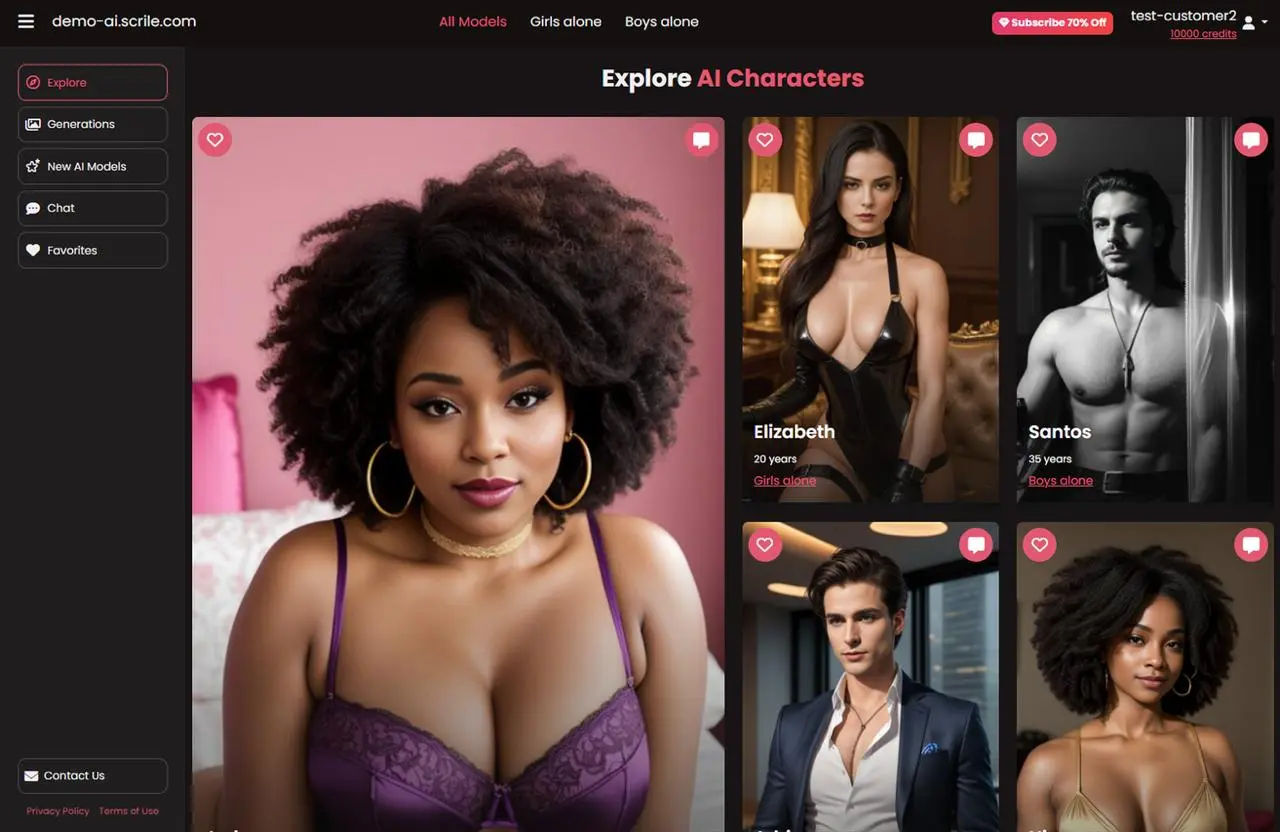
Scrile AI is a platform for building your own AI-powered applications with privacy, consent, and compliance at the core. Instead of gambling with black-box “free undress” tools, you work in an environment where you define what your model can and cannot do — and how every image or data point is handled.
Whether you are:
a fashion-tech brand prototyping virtual fitting rooms and body-shape estimation,
a creator platform building safer NSFW tools that only work with verified, consenting models,
a healthcare or education provider creating anonymised anatomical simulations, or
a media or gaming company generating realistic avatars and characters,
Scrile AI gives you the infrastructure and expert support to ship these ideas without compromising on ethics or data security.
Scrile AI distinguishes itself by building AI-powered solutions that are safe, transparent, and built for true business growth. Companies and content creators have a choice of either safe products, like Scrile AI, or unreliable free undress AI websites that compromise privacy or legality. Businesses are empowered to build their own custom artificial intelligence tools to your needs and specifications—with complete control. Scrile AI is more than a product—it is a secure foundation on which you can innovate.
What Is Scrile AI?
Scrile AI is a solution that allows you to create, train, and deploy AI models for any of your business goals. Whether you are building a creative AI image editor, a personalized chatbot, or a recommendation engine, Scrile AI includes the infrastructure and expertise to make it securely.
The single biggest difference between Scrile AI and open or free AI tools is control. With Scrile AI, you own the model, manage your own data, and set the use cases—and can ensure that you comply with privacy laws like GDPR and CCPA. No mystery regarding your data—where it goes and how it is used. Everything is intended to be transparent, safe, and ready for business.
Some Benefits of Using Scrile AI
With Scrile AI, you get:
Customisation by design – define your own prompts, allowed use cases, safety filters, and output rules.
Data ownership & governance – your training data and user content stay under your control, with clear retention and deletion policies.
Built-in compliance – architecture and workflows that can be aligned with GDPR, CCPA, and industry-specific regulations.
Security best practices – hardened infrastructure, access control, and monitoring instead of unknown third-party servers.
Expert guidance – a team that helps you move from “we have an idea” to “we have a deployed, auditable AI product.”
Explore Scrile AI and start to develop your tailored AI product now, guided by trust, innovation, and ethics.
Get a free demoExamples of Ethical Products You Can Build with Scrile AI
Here are just a few ideas that use similar underlying technology to “undress AI”, but in a lawful and consent-based way:
A virtual try-on tool that helps shoppers understand how clothing fits their body type without over-collecting personal data.
An adult creator platform where models can generate AI-enhanced content of themselves, fully opt-in, with automatic watermarking and logging.
A content safety layer that detects, flags, and blurs sensitive imagery before it reaches the public.
A training simulator for medical or wellness education that uses synthetic bodies instead of real patient photos.
Instead of fighting against the technology, Scrile AI helps you channel it into products that users, regulators, and your legal team can stand behind.
Our Experience: “Free AI” usually creates risk, not a real business moat
In AI projects, we repeatedly see the same pattern: free tools can look attractive in demo mode, but real products need data control, predictable infrastructure, and clear consent rules. That matters even more in sensitive image workflows, where mistakes impact both UX and legal safety. In the CamSupreme case, the team didn’t rely on random free generators — they built a controlled platform model: live + AI performers active 24/7, built-in payments, subscriptions, and admin controls. The result: monetization started in 1 month and stabilized at $5,000+ monthly customer spend with around ~$1,500 monthly admin profit. The practical takeaway is simple: value comes from a safe, systemized product loop — not from “free generation” alone.
Read also
| Article | What you’ll learn | When to read |
|---|---|---|
| Undress AI | Broadens the discussion from free-only choices to the overall undress AI category and its main tool types. | When you want to see what exists beyond zero-cost options. |
| AI Clothes Remover | Helpful for readers comparing free undress tools with clothes-removal tools that may frame the same capability differently. | When you want to compare wording, features, and likely output styles. |
| Nudify Free | A very close companion topic that reinforces the free-access side of the niche and helps compare similar discovery paths. | When you want more no-cost options in the same category. |
| AI Nude Undress | Adds a more explicit query angle for readers who want to move from general free undress tools to nude-output expectations. | When you want to clarify exactly what result you are looking for. |
| Clothes Remover AI Tool | Useful for readers who want to compare free options with more utility-oriented tools that may be better structured or more feature-rich. | When you want to balance price with product quality. |

Polina Yan is a Technical Writer and Product Marketing Manager at Scrile, specializing in helping creators launch personalized content monetization platforms. With over five years of experience writing and promoting content for Scrile Connect and Modelnet.club, Polina covers topics such as content monetization, social media strategies, digital marketing, and online business in adult industry. Her work empowers online entrepreneurs and creators to navigate the digital world with confidence and achieve their goals.
Very good article. I will be dealing with some of these
issues as well..
Great article, thank you for sharing these insights!
Spot on with this write-up, I honestly feel this site needs
far more attention. I’ll probably be back again to see
more, thanks for the info!
It’s not my first time to visit this web site, i am browsing
this website dailly and get pleasant facts from here
daily.
You have made some good points there. I checked on the internet
to find out more about the issue and found most people will go along with your views
on this web site.