Quick answer
Create a separate OnlyFans promo account when your personal audience is the wrong fit, your creator content needs firmer privacy boundaries, or a channel requires its own posting style. Keep your existing identity when it already attracts suitable fans and public association carries little risk. Separation alone does not guarantee anonymity: shared recovery details, contacts, devices, photos, usernames, locations, or careless cross-links can reconnect the identities.
Should you create a separate OnlyFans promo account?
Use a separate OnlyFans promo account when you need to separate audiences, presentation, or operational risk. Do not create one merely because separation feels safer: an extra username is a workflow choice, not an invisibility cloak.
The expensive mistake is choosing an account structure after promotion has started. A creator may post from a personal profile, attract curious acquaintances instead of likely buyers, then hurriedly open new accounts and lose recognizable handles, saved content, and clean attribution. The reverse also happens: someone builds an elaborate persona across six channels before proving that one channel can produce useful conversations. Both failures come from treating accounts as decorations rather than routes through a business.
- Keep your existing identity if its audience fits the offer, public association is acceptable, and the content style can remain consistent.
- Create one separate creator persona if you need a durable public identity with its own voice, boundaries, and visual presentation.
- Create channel-specific accounts only when a platform needs materially different content, moderation, administration, or audience handling.
- Pause before launching if you cannot explain who controls recovery, what may be cross-linked, or how an abandoned account will be closed.
Judge the choice on five criteria: audience fit, privacy consequence, brand consistency, workload, and ownership. Privacy consequence asks what happens if the creator and personal identities become connected—not whether you hope they never will. Workload includes messages, moderation, security checks, and content adaptation. Ownership covers access and recovery if an assistant or agency relationship ends. Review the relevant onlyfans promotion rules before deciding what each public account may publish or link.

Build an account-architecture worksheet before opening profiles
Map every proposed account in one worksheet. Give it a single job, an accountable operator, an approved identity boundary, and a defined exit. If a field is unknown, the account is not ready to launch.
| Account type | Best use | Boundary | Main risk | Required control |
|---|---|---|---|---|
| Existing identity | Relevant audience already trusts you | Personal and creator identity may be connected | Unwanted discovery or mixed expectations | Explicit comfort with public association |
| Separate persona | One durable creator brand across channels | Personal details stay outside public content | Connections leak through operations or media | Dedicated recovery and content standards |
| Channel-specific account | A platform needs distinct formats or moderation | Same persona, narrower channel purpose | Account sprawl and inconsistent branding | Named owner and retirement trigger |
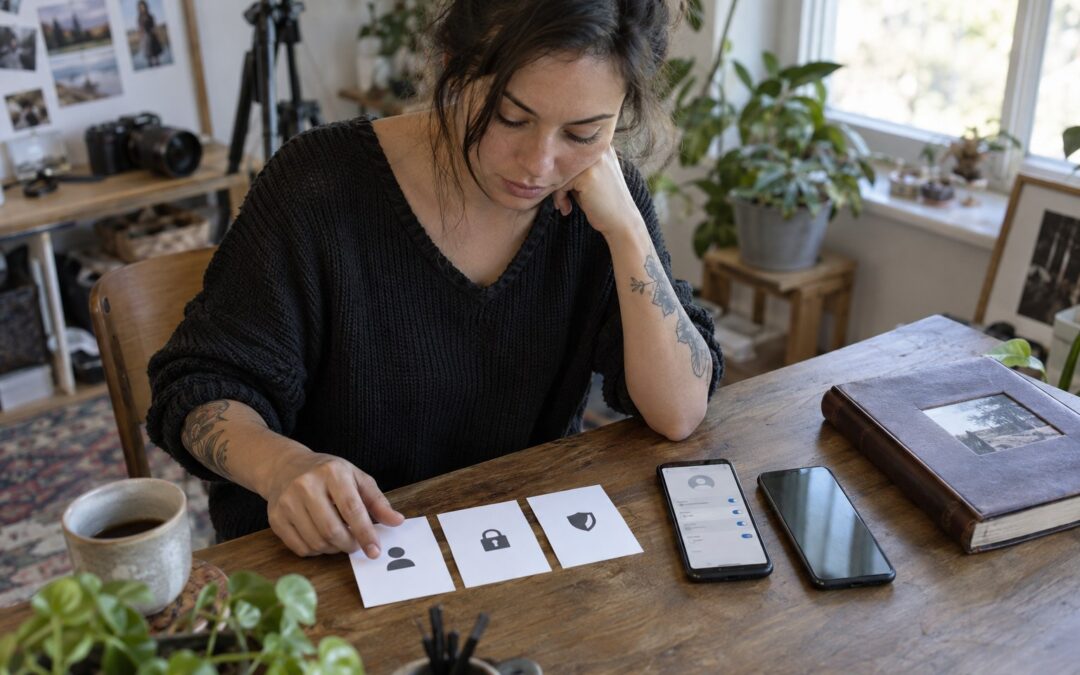
For each row, record the public handle, login email, recovery method, administrator, content purpose, allowed cross-links, forbidden identity clues, destination URL, and retirement procedure. Recovery access deserves special attention: a creator should not discover during a lockout that an old manager controls the only usable address. Store credentials securely, enable the strongest authentication available, and keep recovery details current without exposing them publicly.
Cross-links should form an intentional route, not a plate of spaghetti. Decide whether a social account links directly to the paid profile or first sends visitors to an onlyfans landing page where context, age-appropriate presentation, and alternative destinations can be managed. Record which accounts may mention one another. Never connect a personal profile to a persona casually; a single follow, contact suggestion, reused bio, or background detail can undo months of careful separation.

How does the account plan work in practice?
Start with the smallest structure that preserves the creator’s real boundary. One persona, one primary discovery channel, and one conversion route are usually easier to operate and diagnose than a fleet of nearly empty profiles.
Assume Maya has an established personal Instagram followed by relatives, local clients, and friends. She wants to sell glamour content under the persona Mara, does not want to advertise that work to personal contacts, and can reliably maintain three promotional channels. Her plan assigns Mara one shared public identity across a short-video account, a Twitter account, and a Reddit account. The personal Instagram neither follows nor mentions them. This reduces audience confusion, but it does not promise that nobody will connect Maya and Mara.
Her operating assumption is five promotional placements per channel each week. Three channels multiplied by five placements equals 15 weekly placements. She labels every destination by channel so she can compare visits and paid actions without guessing. The number is a workload model, not a performance forecast: fifteen weak posts are still fifteen weak posts. She reviews whether each channel earns its maintenance burden before adding another. Her Reddit workflow also follows the community-specific guidance for onlyfans subreddits, while her short-form posts use safer previews.
- Reserve the persona handle and recovery route before publishing.
- Create one approved bio, visual boundary, and destination path.
- Launch the primary channel first and test the full visitor journey.
- Add the second and third channels only after access, moderation, and measurement work.
- Review channel contribution and retire accounts that lack a defensible role.
This example produces a useful diagnosis. If people see the posts but do not visit the destination, the creative or call to action is weak. If they visit but do not subscribe, the offer, profile, trust, or pricing needs attention. If one channel creates relevant conversations while another creates harassment and admin work, equal posting volume is not a virtue. The purpose of channel labels is decision-making, not decorative analytics. Maya can shift effort without rebuilding the persona because identity and distribution were designed as separate layers.
What can separate promo accounts protect—and what can they not?
Separate accounts can reduce accidental audience mixing and limit routine operational exposure. They cannot guarantee anonymity, prevent screenshots, erase biometric recognition, or override a platform’s verification and compliance requirements.
Identity can reconnect through obvious details such as faces, tattoos, rooms, locations, usernames, and mutual contacts. Less visible connections matter too: reused recovery addresses, shared administrators, synchronized contact books, public business records, invoices, or a personal account that repeatedly interacts with the persona. A separate device or browser profile may reduce ordinary mistakes, but it should support a clear operating boundary rather than create false confidence.
More accounts also increase creative and security debt. Each one needs suitable posts, replies, moderation, authentication, recovery, policy awareness, and eventual closure. Channel-specific profiles make sense when the audiences or formats genuinely differ; cloning the same feed everywhere often creates work without clarifying demand. A creator whose existing identity already supports the offer may gain more from consistent positioning than from starting again at zero.
Platform choice changes the exposure pattern. Public conversation can make twitter onlyfans promotion useful for personality and repeat contact, but it also makes replies and associations visible. Dating services are a poor substitute for consent-based creator marketing, and private messaging can become unmanageable without boundaries. Avoid fake engagement and shortcuts such as attempts to buy onlyfans subscribers; impressive-looking numbers do not repair weak audience fit or create operational control.
Launch the structure without building an account maze
Implement the architecture in dependency order: define the boundary, secure ownership, prepare the destination, launch one acquisition channel, verify the journey, and only then expand. Every account must earn its place.
- Write the identity boundary: what the persona shows, says, avoids, and never links.
- Choose handles and assign one secure login, recovery route, and accountable administrator to each account.
- Prepare the paid offer and destination before attracting attention.
- Create a small bank of channel-appropriate promotional content and moderation responses.
- Publish on one primary channel, then test every link and public profile as a visitor.
- Track visits, paid actions, questions, safety incidents, and maintenance burden by channel.
- Expand, revise, or retire accounts during a scheduled review—not during a panic.
The destination is the commercial center of this system. Social accounts should introduce the persona and attract suitable attention; they should not be the only place where the business identity lives. An owned domain gives a creator a stable branded destination even while individual acquisition channels change. The broader onlyfans website decision is therefore connected to promo architecture: ownership of the destination determines how much rebuilding follows a platform restriction or strategic move.
Before launch, complete one verifiable test. Sign out of all accounts, open each promo profile as a stranger, follow every permitted path, and confirm the same name, promise, visual identity, and destination appear throughout. Then inspect the path for forbidden cross-links and personal clues. Record the date, reviewer, and fixes in the worksheet. That simple acceptance test turns “I think the accounts are separate” into an operating result someone else can check.

Turn promotion into an owned creator business
A careful promo architecture solves distribution and identity boundaries, but it also exposes a larger dependency: every social account ultimately needs a commercial destination. If that destination belongs entirely to another platform, the creator still controls only part of the journey.
Scrile Connect is a white-label platform for launching a branded fan and subscription site under your own domain. It supports subscriptions, tips, pay-per-view content, paid messages, livestreams, private video calls, flexible payment processing, moderation, age-verification support, and administration for users, payouts, earnings, and analytics. It suits creators, agencies, and founders who want a monetization-first destination without building the initial platform from zero.
That does not remove the need for careful acquisition channels or compliance. It gives the account architecture somewhere owned to lead: a branded destination with controllable pricing, content, rules, and payment flows. Creators comparing community-led traffic options can also examine how onlyfans discords fit—or fail to fit—an audience path before committing more time.
Frequently asked questions
Should I make a separate account to promote my OnlyFans?
Yes if you need a distinct audience, creator persona, or privacy boundary. Keep your existing account if its followers fit the offer and public association is acceptable.
Does a separate OnlyFans promo account make me anonymous?
No. Faces, photos, contacts, recovery details, devices, administrators, locations, and cross-links can reconnect identities. Separation reduces some exposure; it does not guarantee anonymity.
How many promo accounts should a creator have?
Use the fewest accounts that cover genuinely different audiences or formats. Begin with one primary acquisition channel and add another only when you can operate and measure it properly.
Can I use the same creator name on every platform?
A consistent persona name usually reduces fan confusion, but check handle availability and impersonation risk. Channel-specific accounts can still share one public creator identity.
Should promo accounts link directly to OnlyFans?
That depends on platform rules, content restrictions, and the visitor journey. A controlled landing page can provide context and manage multiple destinations, but it adds another step.
Can an assistant manage my promo accounts?
Yes, but define publishing, messaging, link-changing, recovery, and removal permissions. The creator should retain control of essential ownership and recovery routes.
What should I do with a promo account I no longer use?
Remove active links, preserve required records, revoke third-party access, redirect followers where appropriate, and close or clearly decommission the account according to its retirement plan.
What should I track for each promotional channel?
Track visits, paid actions, relevant conversations, repeated questions, safety incidents, and maintenance burden. Evaluate whether the channel supports the business, not merely whether posts receive attention.

Customer success and operations at Scrile. Specializes in corporate administration, project coordination, and the operational mechanics behind B2B retention. Writes about onboarding, retention, and what actually moves customer outcomes.