Quick answer
OnlyFans promotion scams usually sell impressive-looking exposure that cannot be traced to real, relevant people. Before paying, verify the seller’s identity, inspect where the traffic will originate, refuse unnecessary account access, define trackable deliverables, and use a payment method with documented buyer protection. Reject guaranteed earnings, secret traffic sources, rushed payment demands, recycled testimonials, and engagement packages built around bots or fake followers.
Which OnlyFans promotion scams should you reject immediately?
Reject an offer immediately when the seller hides who they are, will not name the traffic source, requests your password or authentication code, guarantees revenue, pressures you to pay now, or refuses trackable deliverables and written refund terms.
The expensive mistake is treating follower count as proof of distribution. A large account can have an irrelevant audience, manufactured engagement, or no control over the pages it claims to use. Listing sites can sell placement on pages nobody visits; traffic sellers can send bots; direct-message promoters can reuse screenshots; and supposed managers can use an access request to take over an account. The common failure is not “paid promotion.” It is buying an unverifiable claim.
- Identity mismatch: the payment recipient, website owner, and person making the pitch cannot be connected.
- Provenance refusal: the seller will not show the specific page, placement, audience context, or acquisition method.
- Access escalation: they request a password, email login, authentication code, recovery code, or control of payouts.
- Outcome certainty: they promise subscribers, income, ranking, verification, or permanent reach instead of a defined placement.
- Payment pressure: they demand crypto, gift cards, friends-and-family transfers, or another method with weak recourse.
- Evidence theatre: testimonials are cropped, duplicated, anonymous, or impossible to verify with the featured creator.
Do not confuse a weak offer with fraud. A legitimate shoutout can still perform badly, and a genuine directory can have little buyer intent. The practical test is whether the seller makes the claim falsifiable: you should know what will appear, where it will appear, when delivery begins, how long it remains, and what evidence closes the job. Compare that discipline with the vetting process for onlyfans shoutouts before deciding that visibility alone has value.
How do you verify a promotion seller before paying?
Verify the offer across six controls: identity, traffic provenance, access, deliverables, tracking, and payment protection. One strong-looking screenshot cannot compensate for a failure in another control.
| Control | Evidence to request | Stop condition |
|---|---|---|
| Identity | Legal or trading name, matching invoice details, working domain, and a live business contact | Names conflict or the seller exists only in disposable messages |
| Traffic provenance | Exact account, site section, audience context, and recent examples of the promised placement | The source is secret, substituted, or described only as premium traffic |
| Account access | Written explanation of the minimum permission required | Password, authentication code, recovery access, or payout control is requested |
| Delivery | Placement format, start condition, duration, creative approval, and replacement terms | The promise is only followers, reach, or guaranteed sales |
| Tracking | Unique destination, campaign label, and seller-side delivery record | The seller forbids tracking or cannot separate your campaign |
| Payment | Invoice, written scope, dispute route, and refund conditions | Irreversible payment is the only option |
Check references outside the seller’s chosen testimonial page. Ask a past client whether the placement ran as described, whether access stayed limited, and whether the traffic resembled real prospects. Do not ask only whether they were “happy”; that question practically invoices itself. For creator partnerships, the same evidence discipline used in onlyfans cross promotion helps separate an accountable operator from a borrowed audience screenshot.

Some legitimate operators protect client privacy and will not expose campaign-level revenue or private account analytics. That is reasonable; total opacity is not. They can still demonstrate ownership of the selling account, show redacted placement examples, describe how visitors are acquired, provide a written scope, and accept measurement through your destination. Privacy should narrow the evidence, not erase it. If a vendor cannot disclose enough for you to distinguish human audience delivery from automated noise, the offer is unsuitable even when the person appears genuine.
How do you test paid promotion without gambling the account?
Run a bounded acquisition test, not an open-ended promise. Define the audience, placement, destination, success event, cost ceiling, and stop conditions before payment; then judge the seller on traceable visitors and qualified actions rather than screenshots.
Use a unique tracking link that leads to a controlled page or clearly attributable profile route. Record visits, profile views where available, subscriptions, renewals, and revenue attributable to the campaign. Vanity engagement is diagnostic at best: likes do not pay renewal bills, and a sudden crowd from the wrong country or niche may be actively unhelpful. A focused onlyfans landing page can keep the message consistent and make traffic sources easier to compare.
Worked example: assume hypothetically that campaign cost is C, attributable first-period contribution after platform and processing deductions is F, and expected later contribution from retained buyers is L. The acquisition cost per paying buyer is C divided by attributable buyers; campaign contribution is F plus L minus C. Before launch, the creator writes that the test stops if the promised placement is missing, the source changes, tracking breaks, or traffic is dominated by obvious automation. After delivery, the seller’s follower count is irrelevant: the decision rests on attributable buyers, contribution, and traffic quality. Compare the result with your OnlyFans customer acquisition cost across channels.
- Archive the offer, seller identity, invoice, placement specification, and refund terms.
- Create a unique destination and approve the exact promotional creative.
- Give only the access needed to deliver the agreed placement; usually that means no account access.
- Capture baseline traffic and sales records before delivery.
- Monitor provenance and quality, enforce stop conditions, and preserve evidence.
- Renew only after attributable economics and audience fit justify another test.

What should you do after paying a scammer or sharing access?
Act in order of account control, money, evidence, and reporting. Secure the email and creator account first, contact the payment provider quickly, preserve the entire transaction, and warn affected partners or fans if the compromise exposed them.
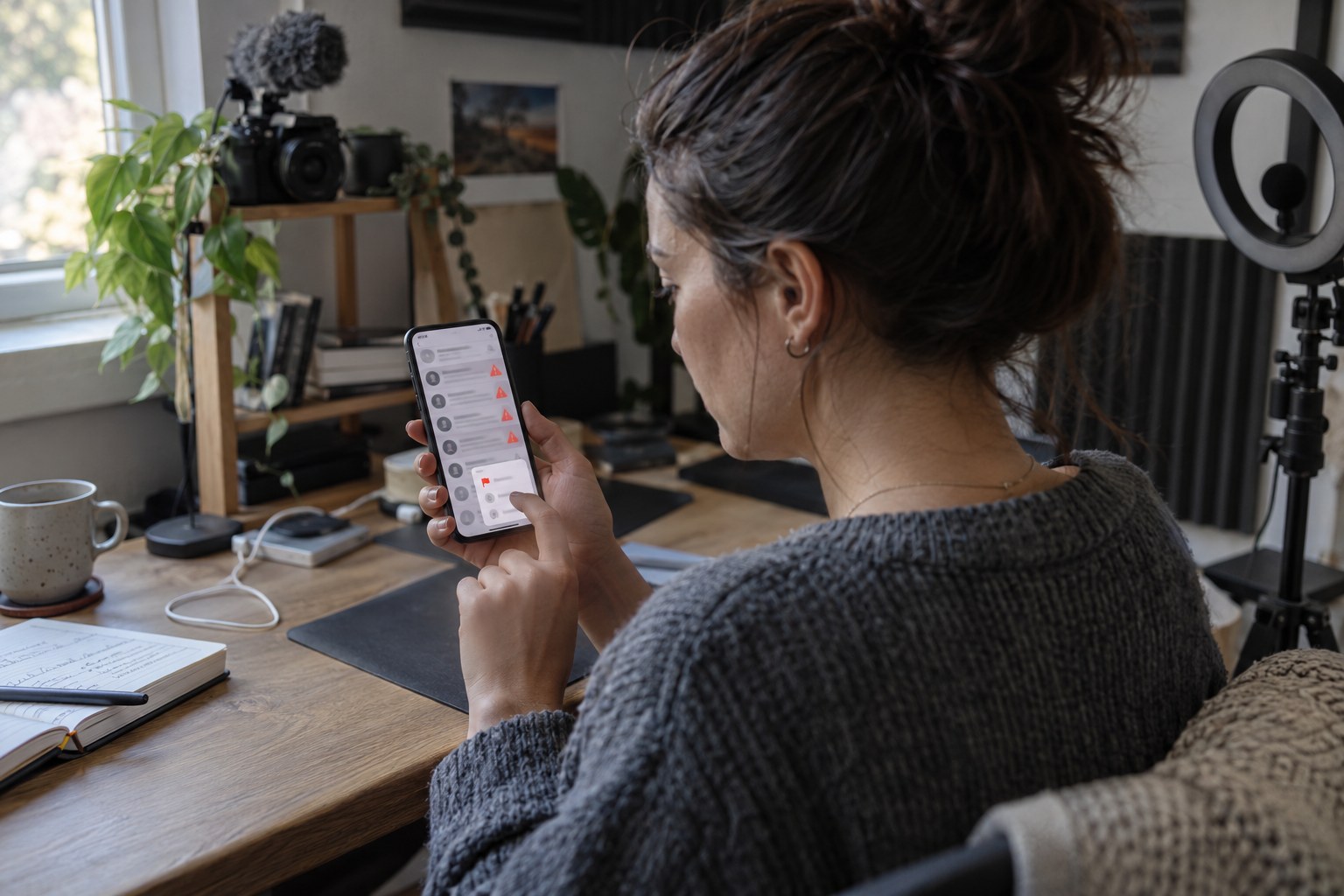
- Change the password on the connected email account, then the creator account and any reused credentials.
- End active sessions, remove unknown devices or applications, reset authentication and recovery methods, and inspect payout details.
- Contact the platform through its official support route if ownership, content, messages, or payment settings may be compromised.
- Notify the card issuer, bank, wallet provider, or payment service; ask what dispute or fraud process applies rather than assuming recovery.
- Save messages, usernames, profile links, invoices, receipts, wallet details, placement promises, timestamps, and screenshots in original order.
- Report impersonation or fraud to the relevant platform and local authority where appropriate; state only facts you can document.
- Tell collaborators what access or material may have been exposed and monitor for copied content or follow-up impersonation.
If you paid for low-quality but delivered promotion, describe the dispute accurately. “The placement did not convert” is different from “the seller never delivered” or “the account was misrepresented.” Clear facts make a payment dispute more credible and prevent you from overstating the case. If intimate content or identity documents were shared, preserve the URLs and evidence before requesting removal; do not repeatedly circulate the material while seeking help.
What promotion buying process should creators adopt?
Adopt a repeatable gate: source offers deliberately, verify claims, contract a limited deliverable, isolate access, track outcomes, and approve renewal only from evidence. This protects good marketing experiments without treating every promoter as a criminal.
Start with channels you can inspect directly and vendors whose audience overlaps your niche. Build a one-page buying record containing identity evidence, traffic source, creative, destination, permissions, payment method, delivery terms, stop conditions, and results. Keep promotion separate from account custody: a marketer may need approved media and a tracking link, but rarely needs your password, inbox, identity documents, or payout settings. Review your onlyfans promotion budget as a portfolio of controlled tests rather than a pot of money waiting for the loudest seller.
This process cannot guarantee profit or detect every sophisticated fraud. New creators may also lack enough conversions to judge a small test confidently, while privacy-sensitive operators may supply limited references. In those cases, reduce exposure rather than relaxing proof: narrow the deliverable, keep control of accounts, require a reversible payment route, and wait for clearer data. Organic promotion may be the better choice when you cannot afford the loss or cannot measure the result.
The deeper lesson is that traffic risk grows when another party controls discovery, customer access, and monetization at once. Build direct audience routes where your brand, policies, data, and payment relationships are less dependent on a promoter’s screenshots or a social algorithm. That does not eliminate acquisition fraud, but it makes vendors easier to replace and results easier to evaluate. Your next action is concrete: create the buying record, define non-negotiable stop conditions, and apply it to the next offer before replying.

Turn promotion into an owned customer path
A safer promotion system tells you which sources deserve more investment. An owned platform gives that measured traffic somewhere branded to land, buy, subscribe, tip, message, or return—without making a promoter the center of the business.
Scrile Connect is a white-label platform for launching a branded fan and content-monetization site with subscriptions, pay-per-view, tips, paid messages, livestreams, private video calls, administration, and flexible payment integrations. It suits creators, agencies, and founders prepared to own both the upside and the operational responsibility.
Frequently asked questions
Are all paid OnlyFans promotions scams?
No. Legitimate placements and partnerships exist, but they can still be poor investments. Verify the seller, source, deliverable, tracking, access needs, and payment terms before buying.
Can a promoter guarantee OnlyFans subscribers?
A credible promoter can define delivery, such as a placement on a specific property, but cannot honestly guarantee how independent viewers will behave. Guaranteed subscribers or revenue are strong warning signs.
Should an OnlyFans promoter need my password?
Usually no. Promotion normally requires approved creative and a destination link, not your password, authentication code, recovery access, email login, or control of payouts.
How can I check whether promotion traffic is real?
Use a unique tracked destination, inspect source and location patterns, compare visits with meaningful actions, and watch for automated behavior. Require the seller to identify the promised traffic source.
Are crypto payments always a sign of fraud?
No, but an irreversible payment can reduce recovery options. Treat it as higher risk when the seller also lacks verified identity, an invoice, written terms, or another protected payment route.
What evidence should I save after a promotion scam?
Save the complete conversation, usernames, profile links, invoice, receipt, payment details, promised deliverables, timestamps, access requests, and evidence of missing or substituted delivery.
Can I recover money from an OnlyFans promotion scam?
Recovery depends on the payment method, evidence, provider rules, timing, and local law. Contact the payment provider promptly, describe the facts precisely, and follow its dispute or fraud process.
When should I stop buying promotion and build my own platform?
Consider ownership when you have repeat demand, can operate moderation and payments responsibly, and need more control over branding, pricing, customer relationships, and monetization than third-party platforms provide.

Account management at Scrile. Writes about B2B sales cycles, vendor-client communication, and the unglamorous middle of enterprise deals.