Starting an OnlyFans agency can look simple from the outside. Find creators, manage their accounts, help with promotion, run chats, and take a percentage of revenue.
But a real agency is not just a group chat, a few chatters, and some traffic tricks. If you want to build an OnlyFans agency as a serious business, you need a system.
You need a clear niche, a strong offer for creators, repeatable onboarding, trained chat operations, content workflows, payment rules, legal basics, reputation protection, and unit economics that actually make sense.
The agencies that survive are usually not the ones promising “we will make you rich fast.” They are the ones that know how to manage creators professionally, track performance, protect trust, and build infrastructure that does not depend on one platform forever.
Quick answer
To start an OnlyFans agency in 2026, begin with a clear niche and a specific service offer for creators. Then build your operating system: creator acquisition, onboarding, content planning, chat management, promotion, analytics, payouts, contracts, and compliance.
Most OnlyFans agencies make money through revenue share, retainers, performance fees, or hybrid pricing.
The business can still be worth it, but only if you treat it like an agency with real processes, not a chaotic side hustle.
What is an OnlyFans agency?
An OnlyFans agency is a business that helps creators grow and monetize their fan base. Depending on the model, the agency may handle marketing, content planning, account management, fan messaging, paid content sales, analytics, strategy, and sometimes creator coaching.
The creator brings the personality, brand, content, and audience potential. The agency brings systems, labor, sales structure, and growth support.
A good agency does not replace the creator. It helps the creator earn more with less operational stress.
A weak agency usually does the opposite. It overpromises, spams fans, burns trust, ignores boundaries, and creates short-term revenue at the cost of long-term reputation.
That difference matters. In 2026, creators are more aware of agency risks. They do not just want “management.” They want proof that you can protect their brand, increase earnings, and operate professionally.
How the OnlyFans agency business model works
The basic OnlyFans agency model is simple: the agency helps the creator increase revenue and receives payment for that work.
But the details can vary a lot. Some agencies focus on traffic. Some specialize in chat sales. Some handle full account management. Some work only with beginner creators. Others work with creators who already have an audience but need better monetization.
The main revenue models are:
| Model | How it works | Best for | Main risk |
|---|---|---|---|
| Revenue share | Agency takes a percentage of creator revenue | Full-service management | Can create conflict if value is unclear |
| Monthly retainer | Creator pays a fixed monthly fee | Strategy, consulting, content planning | Harder to sell to small creators |
| Performance fee | Agency earns based on growth or sales results | Growth-focused services | Metrics must be clearly defined |
| Hybrid model | Smaller retainer plus revenue share or bonus | More balanced partnerships | Requires transparent reporting |
| Service package | Creator pays for a specific service, such as chat or promotion | Narrow specialist agencies | Less control over full results |
Revenue share is common because it aligns the agency with performance. But it also creates tension if the creator feels the agency is taking too much or not doing enough.
That is why transparency matters. The creator should understand what the agency does, how revenue is tracked, how payments are handled, who owns the content, and how the relationship can end.
How to start an OnlyFans agency in 10 steps

Step 1: Choose your OnlyFans agency niche
A common mistake is trying to manage every type of creator from day one. That makes your marketing vague and your operations messy.
A better approach is to choose a niche. Your niche can be based on creator type, content style, audience, geography, platform strategy, or service focus.
For example, you might specialize in:
- Fitness creators who want to monetize private communities.
- Adult creators with existing Instagram or X audiences.
- Beginner creators who need full launch support.
- Creators who need chat sales and fan retention.
- Cosplay creators with strong visual branding.
- Agencies for creators who want to move beyond one platform.
- High-end creators who need premium positioning and VIP monetization.
A niche helps you write a better offer. It also helps you build repeatable workflows because creators in the same category often have similar needs. If your agency is “for everyone,” it will be harder to prove why anyone should trust you.
Step 2: Define your offer for creators
Creators do not hire an agency because the agency “does management.” They hire an agency because they want a specific result.
That result might be more revenue, less time spent in DMs, better content planning, better fan retention, more consistent posting, stronger branding, or a more professional monetization system.
Your offer should explain what you do and what you do not do.
A strong agency offer may include:
- Account audit
- Content strategy
- Posting schedule
PPV and upsell planning - Chat management
- Traffic strategy
- Fan segmentation
- Retention campaigns
- Analytics reporting
- Payout and revenue tracking
- Creator coaching
- Multi-platform monetization strategy
But you do not need to offer everything from the start. In fact, a smaller offer is often easier to deliver well.
For example, a new agency could start with “chat management and fan monetization for creators who already have traffic.” That is much clearer than “we grow OnlyFans creators.”
Step 3: Understand your unit economics
Many people ask how to start an OnlyFans agency, but fewer ask whether the numbers actually work.
That is a mistake.
Before signing creators, think through your unit economics. How much time will each creator require? How many chatters or account managers will you need? How much revenue must the creator generate before the partnership becomes profitable? How much will you spend on tools, staff, outreach, training, and admin?
A creator who earns $1,000 per month may not support a full-service agency model unless your process is very lean. A creator who earns $20,000 per month may justify more team attention, but expectations will also be higher.
You need to know the break-even point.
| Cost or revenue factor | Why it matters |
|---|---|
| Creator monthly revenue | Shows how much commission or fee potential exists |
| Agency percentage or retainer | Defines your income from the creator |
| Chatter/account manager cost | Affects delivery margin |
| Promotion cost | Impacts profitability of growth campaigns |
| Content planning time | Often underestimated by new agencies |
| Admin and reporting time | Becomes heavier as the agency grows |
| Refunds, chargebacks, or failed campaigns | Can reduce real profit |
| Creator churn | Makes acquisition cost more important |
An agency can look profitable on paper and still be stressful if delivery costs are too high.
Your goal is not only to grow revenue. Your goal is to grow profitably.
Step 4: Build your creator acquisition system
To start an OnlyFans management agency, you need creators. But outreach must be careful. Many creators receive spammy agency pitches every day.
A generic message like “we can grow your OnlyFans” will usually be ignored.
A better approach is to show that you understand the creator’s current situation.
You can find potential creators through social media, creator communities, referrals, content platforms, X, Reddit, Instagram, TikTok, and industry networks. But the pitch should be specific.
For example, instead of saying:
“We manage OnlyFans accounts and can increase your income.”
Say something closer to:
“I noticed your audience is active on X, but your paid offer is not very clear from your bio. We help creators turn existing traffic into better fan subscriptions, PPV sales, and retention campaigns. I can send you a short audit if you want.”
This feels more useful and less like spam.
Your first goal is not to close everyone. Your first goal is to start conversations with creators who may actually fit your service.
Step 5: Create a proper onboarding process
Onboarding is where many new agencies fail.
They sign a creator, get access, start messaging fans, and figure things out as they go. That creates confusion fast.
A professional onboarding process should collect everything the agency needs before work begins.
This may include:
- Creator goals
- Brand positioning
- Content boundaries
- Allowed and prohibited requests
- Posting schedule
- Content library
- Pricing menu
- Fan communication style
- Existing traffic channels
- Payment and payout rules
- Access permissions
- Contract terms
- Analytics baseline
- Emergency contact process
The most important part is boundaries. Your team must know what the creator is comfortable selling, what language is acceptable, what content can be promoted, and what requests must be rejected.
Without this, chatters may push too far and damage the creator’s reputation.
Step 6: Set up SOPs before hiring chatters
SOPs are standard operating procedures. They turn your agency from a messy group of people into a repeatable business.
You need SOPs for content posting, PPV messages, fan replies, custom requests, tips, refunds, escalation, content approval, creator communication, reporting, and team handovers.
For chat operations, SOPs are especially important.
A chatter should know:
- How to greet new fans
- How to segment buyers
- When to send an upsell
- Which content can be offered
- What prices are approved
- How to handle custom requests
- When to ask the creator for approval
- What topics are not allowed
- How to report daily performance
- How to avoid misleading or manipulative behavior
This protects the creator and the agency.
It also makes scaling easier. If every manager invents their own process, quality will collapse as soon as you add more creators.
Step 7: Build a content and offer system
Content is not only about posting regularly. It is about creating a monetization flow.
A good agency helps creators turn content into offers.
For example:
Free teaser post → subscription conversion.
Subscriber post → PPV upsell.
Fan message → private content offer.
Tip menu → low-cost buyer activation.
Premium fan → custom request or VIP bundle.
Old content → vault bundle.
High-performing theme → recurring content series.
The agency should know what content exists, what can be resold, what can be bundled, and what should be saved for premium buyers.
This is where many agencies can create real value. They do not just tell creators to “post more.” They help package content into sales moments.
Step 8: Manage chats without damaging trust
Chat management is one of the most profitable and risky parts of an OnlyFans agency.
Good chat operations can increase revenue, improve fan retention, and help creators avoid inbox burnout. Bad chat operations can destroy trust very quickly.
The problem is simple. Fans think they are talking to the creator. If the conversation feels fake, aggressive, or inconsistent, they may leave.
Your agency needs clear rules for chat tone, disclosure strategy, escalation, personalization, and boundaries.
Do not treat fans like wallets. Do not push endless paid messages. Do not promise content the creator will not deliver. Do not let chatters impersonate the creator in ways that create legal or reputational risk.
A better model is to use chat teams to support sales while protecting the creator’s voice and limits.
Quality matters more than volume.
Step 9: Track metrics that actually matter
Many agencies focus only on total revenue. Revenue matters, but it is not enough.
You need to know what drives that revenue.
Important metrics include:
- Subscriber growth
- Subscriber churn
- PPV open rate
- PPV purchase rate
- Average revenue per fan
- Tip conversion rate
- Custom request revenue
- Chat response time
- Revenue per chatter
- Creator retention
- Promotion channel performance
- Refund or complaint rate
These metrics help you understand whether your agency is building a healthy business or just squeezing short-term revenue from fans.
For example, if PPV revenue goes up but churn also rises, your offer may be too aggressive. If chat revenue depends on one top chatter, your system may not be scalable. If creator retention is low, your agency may have a trust or communication problem.
Data should guide your decisions.
Step 10: Handle payouts and financial transparency
Money is one of the main reasons creator-agency relationships break down.
Before work starts, define exactly how revenue is tracked, when payouts happen, what fees are deducted, and how disputes are handled.
Creators should understand:
What percentage the agency takes.
Which revenue streams are included.
Who pays for tools or promotion.
When payments are distributed.
What happens if a fan requests a refund.
How reports are shared.
How the agreement can end.
Do not leave this vague. Transparent payment flows make your agency more trustworthy. They also reduce drama later.
Types of OnlyFans Agencies
Essentially, OnlyFans agencies can be grouped into three categories.
1. Management Agencies
These agencies usually help creators as far as strategic planning, account management, and scheduling content are concerned.
2. Marketing Agencies
These companies advertise and promote creator material as well as work to increase the fan base using various marketing strategies.
3. Management-and-Marketing Agencies
These agencies provide a full approach to enable creators to increase their earnings and ease their workflow.
Your own OnlyFans agency service should definitely be a reflection of your strengths, interests, and the specific needs of your target audience. At the start, new agencies should consider concentrating on a single strategy until they master it. Then they can branch out and diversify their agency model.
Legal basics for an OnlyFans agency
Legal requirements vary by country and business model, so you should speak with a qualified lawyer before launching. But there are basic areas every agency should think about.
You need clear contracts with creators. These should cover services, payment terms, content rights, confidentiality, access permissions, termination rules, dispute process, and responsibilities.
You need age verification and consent processes. Never work with anyone who cannot legally create adult content. Never use or distribute content without proper consent.
You need platform compliance. If you operate on OnlyFans or any other platform, your agency must follow platform rules.
You need data protection habits. Your team may handle sensitive content, payment information, fan messages, creator IDs, and private business data. Access should be limited and controlled.
You also need internal rules for staff. Chatters and managers should know what they can access, what they can say, what they can save, and what happens if they break rules.
Legal basics are not optional. They are part of your operating system.
Ethical and reputation risks
This topic deserves its own section because the OnlyFans agency industry has a reputation problem.
Some agencies overpromise results. Some pressure creators into uncomfortable content. Some use manipulative chat tactics. Some hide revenue details. Some treat creators as replaceable inventory.
That may create short-term income, but it is a terrible long-term strategy.
A serious agency needs ethical rules.
Do not pressure creators to violate their boundaries.
Do not mislead fans about what they are buying.
Do not use stolen or unapproved content.
Do not fake reports or hide revenue.
Do not lock creators into abusive terms.
Do not ignore age, consent, or identity verification.
Do not sacrifice a creator’s reputation for short-term sales.
Your reputation is an asset. If creators trust you, referrals become easier. If fans trust the creator experience, retention improves. If your team has clear rules, operations become safer.
Ethics is not only about being “nice.” It is a business advantage.
OnlyFans agency setup checklist
Before you launch, make sure the basics are in place.
| Area | What to prepare | Why it matters |
|---|---|---|
| Positioning | Niche, creator profile, service focus | Helps you attract the right creators |
| Offer | Clear services, expected outcomes, pricing model | Makes sales conversations easier |
| Legal | Contracts, consent, age checks, platform rules | Reduces serious business risk |
| Onboarding | Creator intake, boundaries, access, content library | Prevents confusion after signing |
| Chat operations | Scripts, SOPs, escalation rules, tone guide | Protects revenue and reputation |
| Content system | Posting plan, PPV calendar, bundles, vault | Turns content into offers |
| Analytics | Revenue, churn, PPV, tips, chat performance | Shows what is working |
| Payments | Payout rules, reporting, deductions, disputes | Builds trust with creators |
| Team | Chatters, account managers, quality control | Makes scaling possible |
| Infrastructure | CRM, content storage, permissions, dashboards | Keeps operations organized |
If one of these areas is missing, your agency may still launch. But it will be harder to scale.
Should you depend only on OnlyFans?
OnlyFans can be the starting point for many creators and agencies. It has brand recognition, monetization tools, and a large audience.
But building your entire agency around one marketplace has risks.
Platform rules can change. Payment issues can happen. Accounts can face restrictions. Competition can increase. The creator relationship may stay tied to the platform instead of your agency’s brand.
That is why agencies should think beyond one channel.
You can still help creators monetize on OnlyFans. But over time, it may make sense to build a broader infrastructure: branded fan sites, independent content libraries, direct subscriptions, PPV offers, private messages, paid calls, and agency-controlled workflows.
This gives the agency more control over the business it is building.
Build your agency infrastructure with Scrile Connect for Agencies
If you want to start an OnlyFans agency as a real business, infrastructure matters.
Spreadsheets, shared passwords, random chats, and manual file transfers may work for one or two creators. But they become risky as soon as you manage more accounts, more fans, more content, and more people on your team.
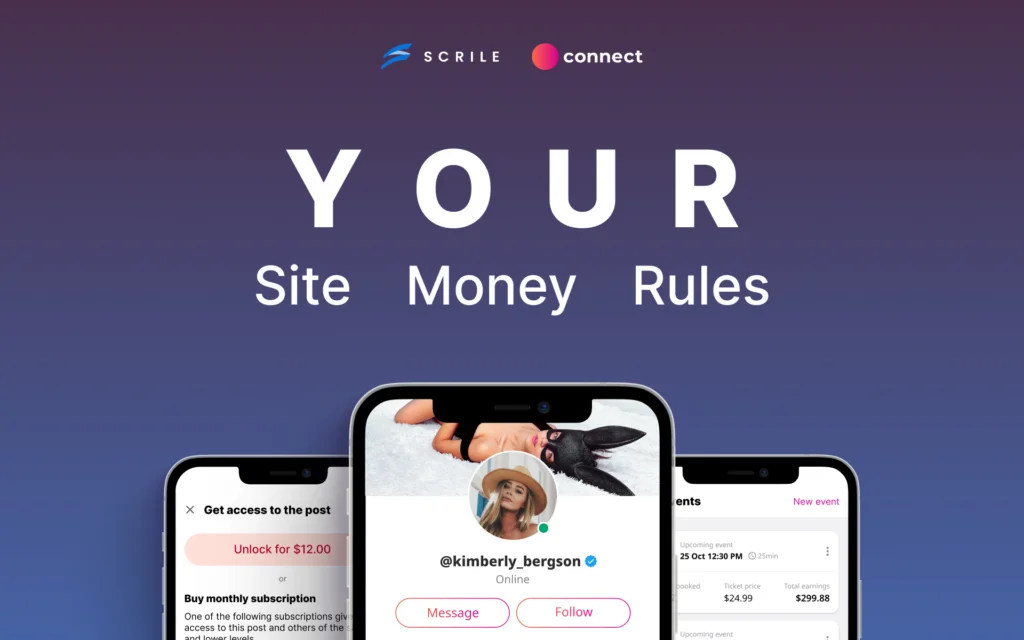
Scrile Connect helps agencies build their own OnlyFans-like platform under their own brand.
Instead of depending only on a third-party marketplace, you can create a branded site where creators publish content, fans subscribe, buyers unlock paid media, and managers help with communication and sales.
For agencies, this solves several important problems. You can:
- manage multiple creator accounts from one admin panel.
- involve account managers and agents in creator workflows.
- use paid attachments and mass messaging to sell content more efficiently.
- upload content into a vault and publish it faster.
- use analytics to understand traffic, audience behavior, and sales performance.
- define your own content policies and fair play rules.
- redistribute payments between creators according to your agency model.
- build promotion value around your own website brand.
Scrile Connect also does not charge a commission fee from payments, which can matter a lot for agency unit economics as revenue grows.
This does not mean every agency should abandon OnlyFans on day one. A more realistic strategy is to use OnlyFans and social platforms for reach while gradually building your own branded infrastructure for loyal fans, direct monetization, and long-term business control.
That is the difference between running an agency inside someone else’s platform and building an asset your agency can actually own.
Ready to build your OnlyFans agency as a real business? Use Scrile Connect to launch your own creator platform, manage creators, organize content sales, and grow under your own brand.
Final thoughts
Learning how to start an OnlyFans agency is not only about finding creators and hiring chatters.
That is the easy part.
The harder part is building a business that creators can trust, fans do not hate, and your team can operate without chaos.
You need a niche. You need a clear offer. You need contracts, onboarding, chat SOPs, content workflows, analytics, payout rules, and ethical standards. You need to understand unit economics before scaling. You need to protect your reputation from the beginning.
The opportunity is still there. But the market is no longer new enough for vague promises and messy operations.
If you want to start an OnlyFans management agency in 2026, build it like a real agency from day one.
Related: OnlyFans Alternatives, AI Chatbots & Agency Guides
| Article | What you’ll learn | When to read |
|---|---|---|
| Twitter OnlyFans | Adds practical acquisition tactics that agencies can use to grow creator visibility and inbound fan traffic. | When you want promotion ideas for your managed creators. |
| Snapchat OnlyFans | Useful for comparing another creator-growth channel that can fit into an agency playbook. | When you want multi-channel traffic strategy, not just one platform. |
| OnlyFans Categories | Helps agencies think more clearly about creator positioning, niche selection, and account differentiation. | When you want to match creators with the right content lane. |
| Adult SEO | Adds a lower-volatility traffic strategy that can support agency growth beyond social platforms. | When you want more durable lead and fan acquisition. |
| How to Make a Social Media | Broadens the thinking from agency operations to the mechanics of the platforms creators depend on. | When you want a more product-oriented view of the market. |
| Tiered Subscription Model | Useful for agencies designing pricing and upsell structures that improve creator revenue, not just traffic. | When you want to optimize monetization after growth. |

Polina Yan is a Technical Writer and Product Marketing Manager at Scrile, specializing in helping creators launch personalized content monetization platforms. With over five years of experience writing and promoting content for Scrile Connect and Modelnet.club, Polina covers topics such as content monetization, social media strategies, digital marketing, and online business in adult industry. Her work empowers online entrepreneurs and creators to navigate the digital world with confidence and achieve their goals.